

The honest answer to what a Paris pop-up costs is that the question is too broad to answer usefully. A three-day stand in a shared space on the edge of the 19th and a month in a flagship unit in the Marais are both pop-up shops in Paris, and the gap between them is not a rounding error. Any single average sits between the two and describes neither.
So this page does two things instead. It gives you the range we actually see across our own Paris listings, with the sample it comes from, and then it walks through what moves a given space up or down inside that range. The second part is the useful part.
If you would rather just look at real spaces with real numbers on them, that is a legitimate shortcut: browse pop-up shops for rent in Paris and filter by area and dates.
The range we see across Paris retail spaces
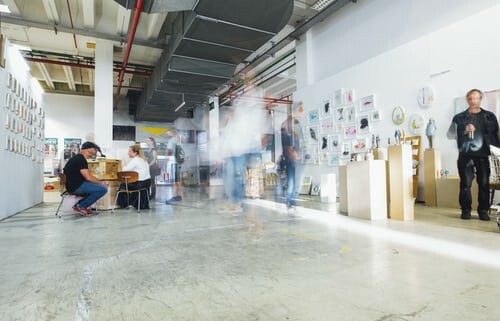
These are asking rates on our own Paris retail listings, in euros, drawn from samples of roughly 150 to 170 spaces per rate type. The figures show the middle of the market rather than the extremes: the lower number is the point a quarter of spaces sit below, the upper number is the midpoint. Plenty of spaces sit above the upper figure, and a few below the lower one.
- By the day: from around €250, with the midpoint around €450
- By the week: from around €1,300, with the midpoint around €2,500
- By the month: from around €3,600, with the midpoint around €7,000
Two warnings about those numbers before you build anything on them.
They are asking rates, not settled ones. Final terms are negotiated directly with the host and depend on duration, exclusivity and timing. A longer booking in a quiet month is a different conversation from three days in late September.
And they are city-wide across retail spaces of very different kinds. Treat them as a sanity check on whether your budget is in the right order of magnitude, not as a quote. If your plan assumes €600 for a week in the Marais, the range tells you something useful. If it assumes €2,000, the range cannot tell you whether that is right, because the answer depends entirely on which €2,000 space.
What actually moves the number
Four things, roughly in order of how much they matter.
Where, at street level rather than arrondissement level
This is the biggest single variable and it is finer-grained than most people expect. Paris is not priced by arrondissement, it is priced by street, and sometimes by which end of the street. The City of Paris runs its own commercial grading of its streets into five categories, which it uses to set the fee for occupying public land outside a shop. That grading is independent of market rents, but it tells you something real: the city itself does not treat all addresses in an arrondissement as equivalent, and neither should your budget.
Practically, a unit on a main commercial artery and a unit two streets back can differ by a multiple, not a percentage. If your number is not working, moving the search one street is usually a better lever than shortening the booking.
How long you take it for
Daily rates are the most expensive way to buy space and the most flexible. The per-day cost implied by the monthly figures above is a long way below the daily rate, which is the normal shape of this market. If your activation genuinely needs eight days, it is worth pricing two weeks before assuming eight days is cheaper.
There is also a legal ceiling worth knowing. Short-term commercial occupation in France usually runs on a bail dérogatoire, and that instrument only works while the total occupation stays under three years. It will not constrain a pop-up, but it explains why landlords think in terms of defined end dates rather than rolling arrangements, and why an open-ended extension is rarely as easy as it sounds.
When
Paris has a pronounced showroom season, and demand concentrates hard into the official fashion calendar. Inside those windows the room to negotiate on price and dates largely disappears, and the spaces that suit a brand audience go first. Outside them, the same unit is a different conversation.
If your dates are movable at all, moving them out of a peak week is the single cheapest change you can make. If they are not, book much earlier than you would elsewhere.
What kind of space
A ground-floor unit with a working frontage, a shop-share corner, a gallery space and a mall booth are all viable pop-up formats and they price very differently. A brand that needs a window is buying something a brand that needs floor area is not. Decide which of those you actually are before you compare prices, because otherwise you will be comparing spaces that are not substitutes.
For brands
Popping up in Paris?
Explore short-term spaces in Paris with Storefront.
Explore Paris spacesFor spaces of this kind, see our selection of affordable commercial property in Paris.
The costs that are not rent
Rent is the number people budget for and rarely the one that breaks the budget. The others, roughly in the order they tend to surprise people:
- Fit-out and making good. What the space arrives as, and what you have to return it to. Ask both questions before signing, not just the first.
- Staff. Either your own people, with travel and accommodation, or local hires. Both are real costs and the second needs setting up in advance.
- Insurance. Cover for the space, the stock and public liability. Hosts will usually tell you what they require.
- Anything on the pavement. Putting a display, a stand or a terrace onto public space in Paris requires authorization from the City and a fee, and the amount depends on that street grading. A single display stand outside the door is within scope.
- Relabelling. If you are coming from a market that shows pre-tax prices, every price on every item has to change, because French retail prices are displayed tax-inclusive. Small cost, easy to forget, and it has to happen before you open.
- Payment processing. Worth checking what your provider charges on cross-border acquiring, because on a short activation that margin is quietly material.
If you are running it from outside France
Two further lines that a French brand never has to budget for.
If your company is established outside the EU, you may need to appoint an accredited fiscal representative in France, which is a real cost with a real lead time. Whether you do depends on your country rather than simply on being outside the EU, and there are exemptions. Getting stock into France is the other one: goods coming back out again can travel differently from goods brought in to be sold, and the two routes cost very different amounts.
Both are covered properly, with the source for each rule, in our guide to VAT, customs and staff for a Paris pop-up run from abroad.
A method that beats a number
Rather than starting from a budget and looking for a space that fits it, the order that tends to work is this.
- Decide what the activation is for. Sales, awareness or a market test all justify different spend and different locations.
- Decide what you actually need from the space. Frontage, floor area, storage, a back room, street access. Be specific, because it eliminates most of the market immediately.
- Pick three candidate areas rather than one, and look at real listings in each. The range above will start to mean something once you have three concrete numbers in front of you.
- Add the non-rent costs before you commit. They routinely come to as much as the space itself on a short activation.
- Then decide whether the total is worth it against what the pop-up is for. If it is not, change the duration or the area, not the ambition.
The single most useful next step is to put real numbers in front of yourself. Browse pop-up shops for rent in Paris, or read the full guide to opening a pop-up shop in Paris.

Written by
Nicholas Roberts-Moore is Chief Marketing Officer at Storefront, based in London. He specializes in AI-powered marketing and the UK retail and real estate markets, helping brands turn short-term retail into measurable growth. A former journalist, he writes on pop-up strategy, retail trends, and the future of physical retail.
More from Nicholas Roberts-Moore →If that is the shape of space you need, browse small stores and boutique spaces in Paris.
Related posts:
 What is a pop-up shop? Everything you need to know to try short-term retail
 How to Set Up a Pop-Up Art Gallery: 8 Steps to Renting and Launching Your Exhibition
 Offline Marketing Ideas for Pop-Up Shops
 The 5 Types of Pop-Up Shops (With Examples) & How to Choose the Right One
 Automotive Pop-Up Shops: How Car Brands Use Temporary Showrooms to Launch, Test and Sell