We use cookies and similar technologies to track your activity and improve your experience.
Sort by
Recommended
See on map
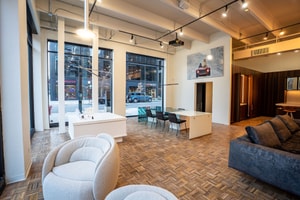
Event Space
∙
River North
2,400 sq ft
from $1,800 per day
See on map
Fast Responder

See on map

See on map

See on map

Event Space
∙
Near North
4,000 sq ft
from $3,600 per day
See on map

Office Space
∙
River North
5,112 sq ft
from $2,001 per day
See on map

See on map

Event Space
∙
Goose Island
1,900 sq ft
from $600 per day
See on map

See on map

See on map

Short-Term Commercial Space in River North, Chicago
River North sits immediately north of the Chicago River and west of Michigan Avenue, and it is where brands, designers and galleries come to test ideas in central Chicago. The district grew out of a warehouse and light-manufacturing quarter, kept its loft buildings, became the city's gallery center, and now holds the densest concentration of restaurants, hotels and design showrooms in the city. For a temporary commercial space, that history produced exactly the right building stock: high ceilings, wide bays, freight elevators, alley loading and ground floors built to be reconfigured.
No other Chicago neighborhood sits within walking distance of that many different audiences: downtown office workers at lunch, hotel guests between check-in and dinner, conventioneers with time to fill, and weekend visitors from the suburbs.
Why River North Works for Short-Term Commercial Space
The building stock is late-nineteenth and early-twentieth-century masonry loft, originally designed for warehouses and showrooms. Timber and steel frames, big windows and high ceilings are standard on most blocks. For a brand bringing its own build, that means a fit-out moves through a loading dock and a freight elevator rather than through the front door, which is easier than almost any European city.
River North also has real availability. The district's ground floors were built for a gallery and showroom economy that has partly moved on, which produced a landlord base used to short terms, used to non-retail uses, and willing to negotiate. A flexible commercial space here is more negotiable than comparable addresses closer to Michigan Avenue.
theMART and the Design Trade
theMART, opened in 1930 as the Merchandise Mart, sits on the river at the district's southern edge and remains one of the largest commercial buildings in the world. It holds the Midwest's design and furnishings showrooms, a technology campus, event floors, a public food hall and its own Brown and Purple Line station. For a design, furniture, kitchen, bath or interiors brand, this single building is the most important address in the Midwest.
During a trade show week, theMART's station becomes the district's peak arrival point, and temporary commercial space within a few minutes' walk trades to a national buying audience that no street location elsewhere in Chicago can assemble. A brand wanting to reach the US interiors trade does it in this part of the city.
The Gallery District
The blocks around Superior, Huron and Franklin held the largest concentration of commercial art galleries in the United States outside New York through the 1980s and 1990s. Although the cluster has thinned as rents rose, a serious core remains. That legacy gave River North a building stock unusually well suited to exhibitions and launches: white walls, high ceilings, freight access and a neighborhood already used to opening nights.
For a gallery activation or a product launch that wants an art-world context, this is the district where the infrastructure and the reputation already exist. Explore more retail space for rent across the platform if your format needs a different setting.
Wells Street and the Retail Corridor
Wells Street runs north through the district a block east of the Brown and Purple Line tracks and is River North's most usable retail street: masonry storefronts, a mix of independents and small chains, and a scale that reads as a street rather than a lobby. It continues north into Old Town, so a customer walking Wells from the river passes through several distinct districts in a short stretch. For a pop-up shop looking for genuine street-level foot traffic rather than a hotel-lobby audience, Wells is the corridor to watch.
Who the Audience Is
River North holds a large share of Chicago's hotel rooms, which gives it a permanent floating population of out-of-town visitors with time and disposable income. That audience, plus conventioneers and downtown workers crossing the river at lunch, is the district's real commercial customer.
What works here is trade-facing, showroom, gallery, hospitality-adjacent and hotel-adjacent formats. Neighborhood retail is a harder fit, because the residential population is high-rise and transient and does its everyday shopping elsewhere. A brand here is trading to visitors, the design trade and people out for the evening, in that order. Chicagoans largely avoid River North's restaurant strip, so if the objective is local credibility rather than visitor volume, look at West Loop or Logan Square instead.
What Affects the Rate
Rates for temporary commercial space in River North vary by size, floor, fit-out level and timing. The real levers a renter controls:
-
Timing. A week with no major convention downtown is quieter and more negotiable than a trade show week.
-
Duration. A longer booking usually earns a better daily rate, because a host is pricing continuity rather than a single let.
-
Floor and finish. Ground floor with a window commands the most. A raw loft space on a higher floor in the same building asks less, and if the brand is bringing its own build, the raw space is the better buy.
-
Position. A side street off Wells or Hubbard asks less than the main run itself while keeping much of the passing trade.
-
Flexibility. Being open on dates, or able to take a space at short notice when a host has a gap, is where a host has the most room to move.
Seasonality in River North
River North is the most weather-proof district in central Chicago because its calendar runs on conventions and hotel occupancy rather than sidewalk foot traffic. A February trade show fills the district while neighborhood corridors across the city sit empty. The design trade's own show weeks bring a national audience into theMART regardless of the temperature outside.
The district's daily rhythm is also inverted: quiet in the morning, busy at lunch, quiet in the afternoon and very busy from six onward every night. A commercial space here that closes at six is trading through the district's slowest hours and closing before its best ones. Evening hours are close to mandatory.
Summer brings a different dynamic. The Chicago Riverwalk opens along the south bank opposite River North, turning the river edge into a promenade with weekend and evening crowds. A site near the water trades two very different halves of the year. For a broader look at what Chicago offers, read our guide on pop-up shops in Chicago.
Getting There
River North is served by both twenty-four-hour lines and the Loop-circling lines, so it has strong transit access through the day and into the early morning. Multiple downtown bus routes cross the district. It is a short walk to the Loop across any of several bridges and minutes to Michigan Avenue. Alley loading is available on most blocks, making large-object moves straightforward in a way that downtown proper largely lacks.
Other Chicago neighborhoods worth comparing: Lincoln Park for a residential corridor audience, South Loop for convention-adjacent space, or River West for a quieter creative setting at a lower price point.
FAQ
What types of commercial space are available for short-term rent in River North?
River North's building stock includes ground-floor storefronts on Wells Street, loft spaces in converted warehouses, gallery-ready white-box units near the former arts corridor, and showroom floors near theMART. Most have freight elevator access and rear alley loading, which makes fit-out and teardown straightforward.
What formats work best in River North?
Trade-facing showrooms, gallery activations, product launches and hospitality-adjacent pop-up shops perform strongest here. The audience skews toward out-of-town visitors, hotel guests and the design trade rather than local neighborhood shoppers, so formats that reward a destination visit tend to outperform everyday retail.
How far ahead should I book a temporary space in River North?
During a major convention or a theMART trade show week, the best spaces fill well in advance. Outside those peaks the district has more availability than its central location suggests, and hosts are used to shorter lead times. Flexibility on exact dates gives the widest choice.
Is River North suitable for evening events and activations?
Yes. The district's foot traffic peaks after six in the evening and runs late every night of the week, driven by the surrounding restaurant and hotel concentration. A space that keeps evening hours here is trading through the district's strongest period.
How does River North compare to the West Loop for a pop-up?
River North draws hotel guests, conventioneers and the design trade. The West Loop draws Chicago's own restaurant and creative crowd. A brand wanting visitor volume and proximity to theMART picks River North. A brand wanting local credibility and a food-world audience looks west.


