

Adore Me built its reputation as a digitally native lingerie brand, challenging the intimates market with inclusive sizing, accessible pricing, and a strong online-first model.
While the brand has experimented with physical retail — including select standalone stores and appointment showrooms — its core strategy remains ecommerce-led. More recently, Adore Me has expanded through wholesale partnerships, including distribution in more than 1,900 Walmart locations, further enhancing its omnichannel footprint.
Rather than shifting away from digital, Adore Me uses pop-up stores and temporary retail activations as strategic tools to test markets, deepen customer engagement, and bridge the gap between online convenience and in-person experience.
We spoke with Iris Voltaire, Adore Me’s Business and Brand Development Associate, about how pop-ups and selective retail experiments support the brand’s broader growth strategy.
From Experiential Pop-Ups to Omnichannel Growth

Adore Me views physical retail as an extension of its digital DNA — not a replacement for ecommerce.
“We’re constantly looking for new innovative offline ideas,” explains Voltaire.
One of the brand’s most memorable activations was a one-day pop-up in a high-traffic New York location. Rather than functioning as a traditional store, it was a 360-degree brand experience in the middle of a busy transportation hub.
The activation featured:
- A live, nine-hour fashion photoshoot
- A 16-foot-wide selfie wall
- Interactive brand moments designed for social sharing
Importantly, no merchandise was sold on-site. Instead, visitors received discount codes redeemable online, encouraging post-visit conversion back to ecommerce.
“These types of engagements are very different from the classic retail store,” says Voltaire. “Visitors were encouraged to engage with the brand offline and go on a shopping spree online when they’re already at home.”
This model highlights one of the biggest advantages of pop-up stores for ecommerce brands: they create brand exposure and customer interaction without disrupting the online sales engine — a core principle we discuss in our complete guide to ecommerce pop-up shops.
Learn more: Bring Ecommerce Brands to Life With Pop-Up Stores
Why Pop-Up Shops Make Sense for a Digitally Native Brand
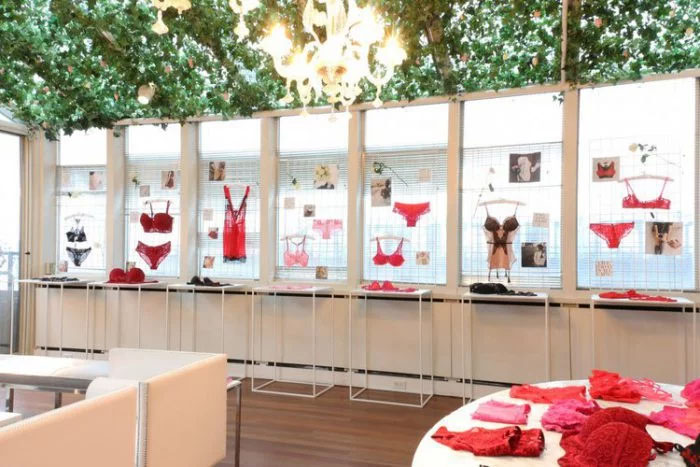
Since launching online, Adore Me has focused on data-driven personalization and direct-to-consumer growth. Physical retail for them is experimental and intentional.
“To fuel further growth, and to articulate a stronger brand statement, we’ve decided to move into brick-and-mortar,” Voltaire explains.
But instead of building a large network of standalone stores, Adore Me has used pop-ups and experiential activations to:
- Increase brand visibility
- Strengthen customer trust
- Test geographic demand
- Gather qualitative insights
This approach reduces long-term risk while delivering real-world feedback that digital analytics alone cannot provide.
The Measurable Impact of In-Person Customer Interaction
“We’ve seen a benefit from customers interacting with the brand in real life,” says Voltaire.
In addition to pop-up activations, Adore Me operates appointment-based showroom experiences, where customers receive one-on-one styling sessions. Stylists assist with measurements, fit guidance, and personalized product recommendations.
For brands
Ready to launch your pop-up?
Find and book your short-term retail space with Storefront.
Find a space“The response to this service has been very positive,” Voltaire adds.
For categories where fit and comfort are critical, physical experiences help remove friction and build confidence — a theme also explored in our article on designing physical retail for omnichannel behavior, including showrooming and webrooming.
Learn more: How to Design a Physical Store That Appeals to Both Webrooming and Showrooming
Pop-Up Shops vs. Permanent Stores: A Strategic Balance
For Adore Me, ecommerce remains the core.
“For us, one does not rule out the other,” says Voltaire. “Adore Me will always stay true to its digital DNA, delivering a strong customer experience across all platforms.”
While the brand has tested standalone locations in the past, it does not operate a large chain of brick-and-mortar stores. Instead, its omnichannel strategy includes:
- Ecommerce expansion
- Wholesale partnerships (e.g., nationwide distribution through Walmart)
- Pop-ups and select physical experiments
This reflects a broader trend: for many DTC brands, pop-ups are strategic testing grounds, not necessarily precursors to wholesale retail expansion.
What Pop-Up Shops Offer That Ecommerce Alone Cannot
“With the nature of e-commerce, the customer will not be able to touch, try or feel the product before she makes a purchase,” Voltaire explains.
Pop-up shops solve this gap by allowing customers to:
- Try on products
- Receive fit guidance
- Experience the brand physically
- Build confidence before committing
Even when purchases occur online afterward, physical interaction increases trust and loyalty.
Adore Me has also experimented with subscription and try-before-you-buy programs that blend ecommerce convenience with real-world sampling. Pop-ups complement these innovations by adding a human, experiential layer.
Choosing the Right Markets
“Our customers are urban millennials, and we will open stores where they are — in the bigger cities across the country,” says Voltaire.
When testing physical retail, location matters. Pop-ups allow brands to validate consumer demand in specific markets before deeper investment — a lower-risk alternative to long-term leases.
For digitally native brands, this type of experimentation often yields stronger strategic insight than moving directly into large store footprints.
The Bigger Takeaway for Ecommerce Brands
Adore Me’s strategy demonstrates that:
- Pop-up stores can increase brand trust and product confidence
- Physical activations can drive online conversion and loyalty
- Short-term retail reduces risk while delivering valuable insights
- Ecommerce and physical retail can coexist strategically
- Wholesale and experiential retail can reinforce each other
For online-first brands, pop-up shops aren’t about abandoning ecommerce — they’re about amplifying it.
Check out the below success stories for further inspiration:
- How Unspun Used a Pop-Up Store in Hong Kong to Test a New Way of Buying Denim
- How HEMA Used Pop-Up Stores in Paris and Amsterdam to Launch a Seasonal Campaign
- How Brompton Uses Pop-Up Stores to Drive Global Retail Growth
- 7 For All Mankind Builds Buzz with Its Pop-Up Store in Le Marais
For brands
Ready to launch your pop-up?
Find and book your short-term retail space with Storefront.
Find a space
Written by
Nicholas Roberts-Moore is Chief Marketing Officer at Storefront, based in London. He specializes in AI-powered marketing and the UK retail and real estate markets, helping brands turn short-term retail into measurable growth. A former journalist, he writes on pop-up strategy, retail trends, and the future of physical retail.
More from Nicholas Roberts-Moore →Related posts:
 Inside the GRAMMAR Pop-Up Store in New York’s Lower East Side
 How The Daily Show Used a Pop-Up Exhibition to Turn Tweets Into an Interactive Experience
 How Design Brand Resident Used a Pop-Up Showroom in New York to Introduce Its Furniture Collection
 How Knotel Used a Pop-Up Showroom in New York to Demonstrate Its Agile Office Concept
 How Venmo Used a Mobile Pop-Up Activation in New York to Launch Its Debit Card