

Marylebone reads as a village a few minutes north of Oxford Street, and that is not an accident of history. Marylebone High Street stays independent-leaning because a single estate owns it and manages the mix that way on purpose.
That one fact changes how you should approach it. Short-term space on the High Street is an estate decision rather than a landlord filling a void, and the estate is protecting a character. You are being selected as much as you are booking. Browse commercial space to rent in Marylebone.
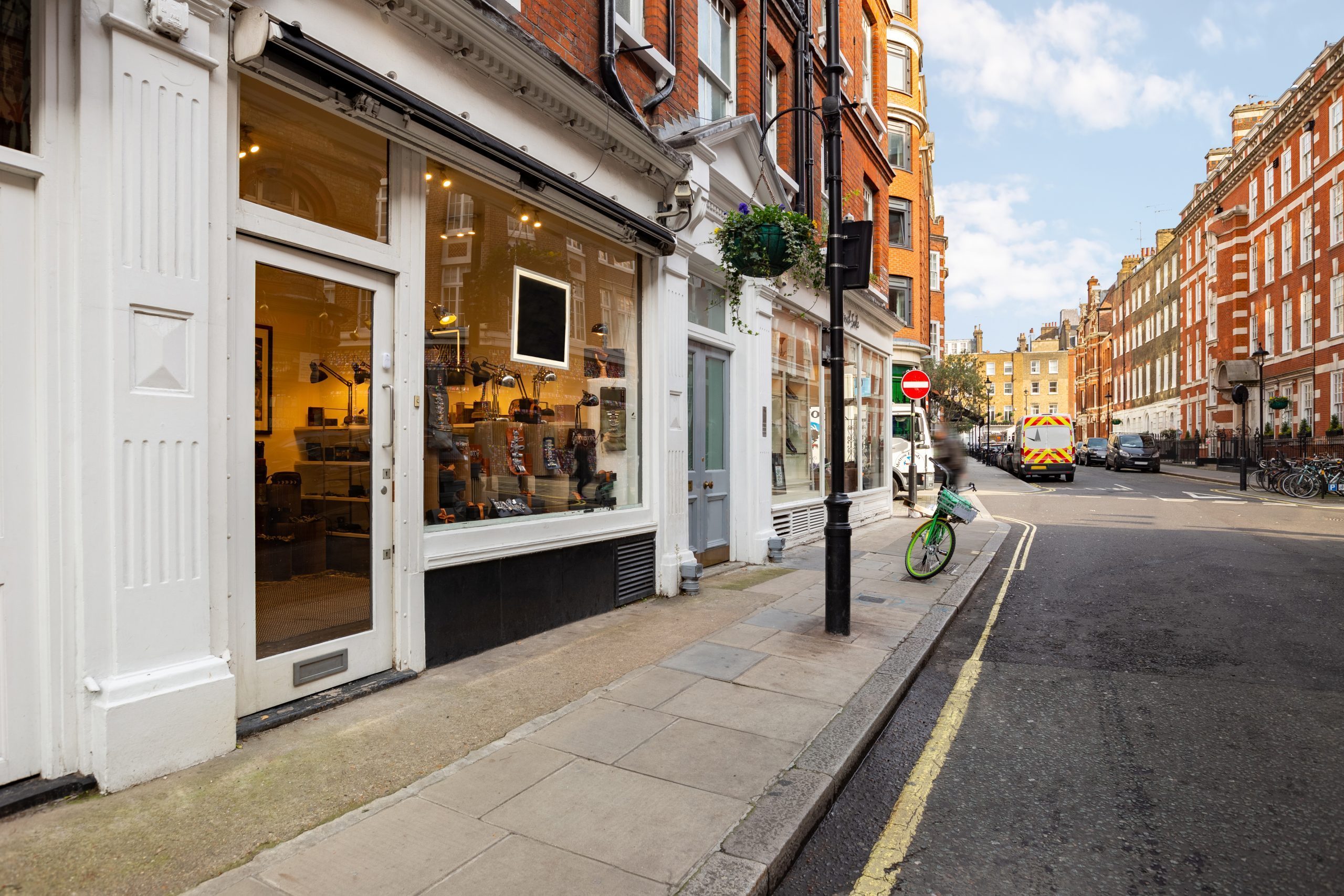
Four districts wearing one name
Marylebone is small, but it is not uniform. Four separate commercial characters sit within a ten-minute walk of each other, and they want different things from a tenant.
Marylebone High Street
The managed, independent-leaning run, and the reason the district has the reputation it does. Units are mid-sized by London standards, wider than the lanes behind but well short of flagship scale, in period buildings with flats above. The pavements are generous for a central street, which makes spill-out seating and queuing workable where the estate permits it.
Marylebone Lane
The most interesting street in the district for a small brand, and the least understood. It curves away from the High Street along the line of an old field boundary, so it holds the smallest and most irregular units in Marylebone. Shops here are genuinely tiny and oddly shaped, which suits a single-category independent and defeats anything needing a standard layout.
Because it curves, nobody sees more than a short stretch of it at a time. The lane trades on discovery rather than sightlines, which rewards a distinctive frontage and punishes any reliance on being spotted from a distance. It is the opposite of how the High Street beside it works, and it is one of the cheaper ways to hold a Marylebone address. The trade-off is explicit: the footfall is a fraction of the High Street’s and the customer is already looking for something specific, so it suits a brand with an audience to direct there rather than one hoping to be found.
Chiltern Street
A short run of independent fashion and instrument shops in red-brick mansion frontages, and one of the most distinctive small streets in central London. Village scale, strong character, and a natural fit for a considered format rather than a volume one.
Moxon Street and Paddington Street
The independent food trade: a cluster of specialist grocers and a weekly farmers market behind the High Street. If your project is food, this is the part of Marylebone that already has the audience for it.
For brands
Popping up in Marylebone?
Explore short-term spaces in Marylebone with Storefront.
Explore Marylebone spacesThe other Marylebone, and it behaves nothing like the High Street
The eastern side runs on the private medical trade around Harley Street and Wimpole Street. That gives it a professional daytime population with appointments rather than an office or shopping one.
It is steady weekday footfall, and the useful detail is that those people have time to spare between appointments. That is a genuinely different customer from the High Street a few streets west, and it goes unnoticed by most briefs. Baker Street and Wigmore Street carry the larger-format retail and office frontage, in contrast to the village scale to the west.
The customer, and why the trading week is unusually flat
The Marylebone customer is affluent, local and habitual, doing a weekly round of specialist food shops and independents rather than a shopping trip. Trade is steady across the week with a weekend lift, and it lacks the peaks and troughs of a commuter or visitor street entirely.
For a short let that is a real advantage and it is rare in central London. You are not buying two good days and five quiet ones, and you are not dependent on a single market morning. Every day of a Marylebone run is worth roughly what the last one was.
What works here
| What | Why Marylebone suits it | Browse |
|---|---|---|
| Retail and pop-up | A managed independent run with an affluent, habitual local customer and a flat trading week. | retail and pop-up space in Marylebone |
| Food and drink | An established specialist food cluster around Moxon Street and a weekly farmers market. | food and drink space in Marylebone |
| Showrooms and press | Premium positioning minutes from Oxford Street without the chain-street rents. | showroom space in Marylebone |
| Events and launches | Period buildings, generous pavements and a district used to hosting at village scale. | event space in Marylebone |
| Meetings and project space | A professional weekday population around Harley Street and the Baker Street offices. | meeting space and offices |
| Shoots | Red-brick mansion frontages, a curving lane and period interiors in a compact area. | shoot space in Marylebone |

Brands that have already done it
Two worth reading before you commit, because both chose Marylebone deliberately rather than by default. VIU Eyewear took their second UK store here on a flexible model, and the lifestyle brand Mantidy launched a pop-up on the High Street. The pattern in both is the same: a premium, design-led proposition that would have been lost on a chain street a few minutes south.
Getting there
Marylebone is served by Baker Street, Bond Street, Oxford Circus, Great Portland Street, Regent’s Park, Edgware Road, Marylebone and Warren Street. The busiest of them, Oxford Circus, is among the fifteen busiest stations in London by annual entries and exits, which is a useful proxy for the through-traffic a ground-floor unit on the southern edge can expect.
The London Plan treats Marylebone High Street as a CAZ retail cluster, a significant mixed-use cluster inside the Central Activities Zone with a predominantly retail function. In practice it behaves like a town centre without being a freestanding one, which is a fair description of how it trades.
The rules
- The estate is the first gate, not the planning system. On the High Street and the Lane you are dealing with a single landlord managing a tenant mix. Expect to be asked what you are rather than only what you will pay.
- Use Class E covers shops, offices, cafes and gyms in one category, so moving between those uses inside a unit generally does not need planning permission.
- Sunday trading is set by shop size. Up to and including 280 square metres, any day or hour. Marylebone units sit comfortably under that.
- Much of the area is in conservation areas, so signage and shopfront alterations are controlled and consent is slower than people expect. Plan around the frontage as found.
- The Congestion Charge and ULEZ apply. The charge runs 07:00 to 18:00 Monday to Friday and 12:00 to 18:00 at weekends and bank holidays.
How Marylebone compares
- The West End. Oxford Street a block south is the busiest shopping street in Europe, large-format and chain-tenanted. The same brands that fill Marylebone would be priced out of it.
- Mayfair. South west, the luxury address, higher rents and a different customer again.
- Fitzrovia. East across Great Portland Street. Office-led, weekday, and it empties at the weekend where Marylebone does not.
Our London pop-up shop guide covers the city end to end, the neighbourhood ranking places Marylebone against the other main districts, and the best streets guide goes street by street.
Common questions
Why is Marylebone High Street so independent?
Because one estate owns it and manages the tenant mix that way deliberately, a few minutes from Oxford Street where the same brands would be priced out. The independents are there by selection, and short-term space is offered as part of maintaining that character.
Is Marylebone Lane worth it?
For the right brand, yes. It is one of the cheaper ways to hold a Marylebone address, but the units are tiny and irregular and the lane curves, so it trades on discovery rather than passing trade. It suits a brand with an audience it can direct there.
What is the trading week like?
Unusually flat for central London. Steady across the week with a weekend lift, without the peaks and troughs of a commuter or visitor street. Every day of a run is worth roughly what the last one was.
Who is the customer?
Affluent, local and habitual, doing a weekly round of specialist food shops and independents rather than a shopping trip. On the eastern side it is different again: a professional daytime population around the Harley Street medical trade, with time between appointments.
Which street should I be looking at?
The High Street for a managed independent run, Marylebone Lane for something tiny and discovery-led, Chiltern Street for distinctive character, Moxon Street for food, and Baker Street or Wigmore Street if you need larger-format frontage.
How does it compare with Oxford Street?
They are a block apart and nothing alike. Oxford Street is the busiest shopping street in Europe, large-format and chain-tenanted. Marylebone is village-scale, independent-leaning and managed to stay that way.
Where to look next
Browse retail and pop-up space in Marylebone, food and drink space, showrooms, event space, shoot space or everything in Marylebone.
Nearby: Fitzrovia, the West End and Mayfair. For the wider city, see our London guide, the neighbourhood ranking and the Fitzrovia guide.

Written by
Nicholas Roberts-Moore is Chief Marketing Officer at Storefront, based in London. He specialises in AI-powered marketing and the UK retail and real estate markets, helping brands turn short-term retail into measurable growth. A former journalist, he writes on pop-up strategy, retail trends and the future of physical retail.
More from Nicholas Roberts-Moore →Related posts:
 Pigalle Neighborhood Guide: Pop-Up Shops, Showrooms and Creative Spaces
 Exploring the Benefits of Opening a Pop-Up Store in Shanghai
 Pop Up Shops in Chicago: The Complete Guide to Opening a Temporary Retail Space
 The Ultimate Guide to Launching a Successful Pop-Up Shop in Dubai
 East Village NYC Guide: Pop-Up Shops and Small Stores