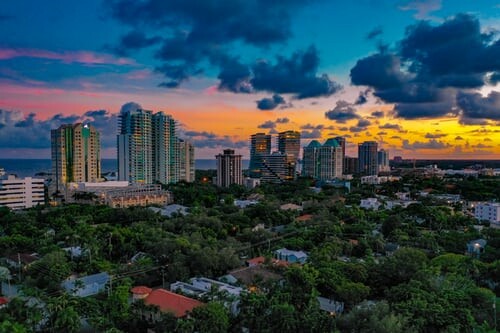
Coconut Grove is the oldest continuously inhabited neighborhood in Miami and it still reads as a village inside the city: leafy, low-rise, on the water, built around the junction of Grand Avenue and Main Highway. It is the part of Miami that feels least like Miami, and that is exactly what it sells.
It is also small. The walkable core runs a few blocks and the units are sized for independents, so the Grove rewards some projects and simply cannot host others. This guide covers who actually turns up, why the tree canopy is a commercial asset rather than scenery, the one weekend a year that changes everything, and how Coral Gables next door operates under completely different rules.
A village inside the city
The Grove is low-rise streets, sailing clubs and independent retail, and its scale is the first thing to plan around. Units are small and low-rise, suited to independents rather than large formats. A brand needing floor area will not find it here, and trying to force a big format into the village is the most common way projects go wrong.
CocoWalk is the district’s open-air retail and dining center and the main concentration of leasable retail in the Grove. It was rebuilt to add offices and to reposition the district away from its nightlife-heavy past, which is worth knowing if your impression of the Grove is a decade out of date.
The tree canopy is a commercial asset
The Grove is unusually green, with a dense canopy over low-rise streets. That shade makes walking comfortable in months when most of Miami is not walkable at all.
Treat that as a practical commercial advantage rather than as atmosphere. Miami’s summer is the season when footfall collapses across most of the city and outdoor dwell time disappears. The Grove holds up better, which makes it one of the few Miami addresses where a summer project is a reasonable proposition rather than a compromise.
Who actually turns up
The Grove’s customers are residents and weekend visitors from across the city rather than tourists, and the district trades on daytime and early evening rather than late night. That audience suits food, wellness and independent fashion far better than it suits a flagship.
One caution on the obvious anchor. Vizcaya Museum and Gardens sits on the bay at the northern edge of the Grove and is one of the most visited attractions in Miami, but its visitors arrive by car for the house and gardens and rarely continue into the village retail. Do not underwrite a project on Vizcaya footfall.
For brands
Need a meeting or event space in the Grove?
Find your space in Coconut Grove with Storefront.
Explore Coconut Grove event spacesThe waterfront pulls footfall into the streets
The Grove’s waterfront holds marinas, sailing clubs and Regatta Park, and the sailing culture is a genuine part of the district’s identity rather than a decorative one.
The practical consequence is that events on the water pull footfall into the village streets. If you are timing a short project or an evening, the water calendar is worth reading alongside the retail one, because a regatta weekend brings people into the Grove who would not otherwise have made the trip.
The Arts Festival is the biggest day of the year
The Coconut Grove Arts Festival is held over the Presidents’ Day weekend in February and closes the village streets to traffic, drawing a very large crowd. It is the district’s single biggest footfall event of the year by a distance.
For a temporary project that cuts both ways. The weekend is the best trading window the Grove offers and it is booked accordingly, so plan far ahead if you want it. It is also a street closure, so deliveries, load-in and vehicle access all change, and a project that assumed normal servicing will have a difficult morning.
Permits here are City of Miami
Coconut Grove is part of the City of Miami despite feeling like a separate town, so its permits, Certificate of Use and Business Tax Receipt follow City of Miami process. That surprises people who assume it is its own municipality like Coral Gables next door.
It also means the guidance that applies to Downtown, Brickell and Wynwood applies here too, and that anything written for South Beach, which is in the City of Miami Beach, does not.
Coral Gables next door runs on different rules
Coral Gables is a separate city south west of Miami, planned in the 1920s by George Merrick as a Mediterranean-revival garden suburb and one of the first planned communities in the United States. The look was the product from the start, which is why its rules are unusually prescriptive.
It regulates shopfronts, signage and even paint colors tightly in order to hold that architectural character, and its permitting is its own and more restrictive than the City of Miami’s. A brand planning its standard storefront treatment should expect to adapt it here, and a temporary fit-out needs more lead time than anywhere else in the county. Budget the approval time before you budget anything else.
What you get for that is a steady, affluent, local audience that is older than Wynwood’s, with a substantial daytime office population from the corporate towers on Ponce de Leon Boulevard and a term-time layer from the University of Miami campus. Trade is steady across the week and across the year rather than seasonal, which is unusual in Miami.
- Miracle Mile. Four blocks of independent retail and restaurants. Residents, not visitors.
- Giralda Avenue. A pedestrian restaurant street, and the district’s evening economy.
- The Shops at Merrick Park. Upscale open-air center, the one destination address.
For brands
Looking for space in Coconut Grove?
Explore short-term spaces in the Grove with Storefront.
Explore Coconut Grove spacesCommon questions
Is Coconut Grove good for a meeting or a corporate event?
It works well for anything that benefits from being somewhere pleasant rather than somewhere central. The village scale, the canopy and the waterfront give it an atmosphere Downtown does not have, and the trade-off is that the spaces are small. For a large delegate count, Downtown’s transit and capacity are the better fit.
Can I run a large-format pop-up here?
Realistically no. Grove units are small and low-rise and the walkable core is only a few blocks. If you need floor area, look at Wynwood’s warehouse stock or Downtown instead, and use the Grove for something intimate.
When is the best time of year?
The Presidents’ Day weekend in February, when the Arts Festival closes the streets, is the single biggest footfall window. Beyond that the Grove is one of the few Miami districts where summer is genuinely workable, because the tree canopy keeps the streets walkable when the rest of the city empties out.
Is Coconut Grove in Coral Gables?
No, and the difference matters. Coconut Grove is part of the City of Miami. Coral Gables is a separate city with its own permitting and much stricter controls on shopfronts, signage and color. Two neighboring districts, two different processes.
Which suits an independent brand better, the Grove or Coral Gables?
The Grove for food, wellness and independent fashion aimed at residents and weekend visitors. Coral Gables for a steadier, older, more affluent customer and a daytime office crowd, provided you can live with the design controls and the lead time they add.
Where to look next
Coconut Grove suits projects that want atmosphere and a local audience, and it punishes projects that need scale. Decide which of those you are before you look at a single unit, because the village cannot be made bigger.
To see what is available: event spaces in Coconut Grove, meeting rooms, pop-up and retail space, showrooms, the whole of Coconut Grove, or Coral Gables next door. For a different Miami again, the Wynwood guide covers the warehouse and gallery end of the city, and the Design District guide covers the luxury end.

Written by
Adrien Kerbrat is Chief Revenue Officer and co-founder of Storefront. With more than 10 years in commercial real estate, he is an expert on the French market and short-term retail across Europe. Based in Bordeaux and often in Paris, he writes on pop-up strategy, retail location, and the French retail landscape.
More from Adrien Kerbrat →