
Downtown Los Angeles is not one place, and treating it as a single area is the mistake that wastes the most time in an LA brief. Bunker Hill is civic and cultural. The Historic Core is nightlife and adaptive reuse. The Fashion District is wholesale. Little Tokyo is food and specialty retail. The Arts District is galleries and warehouses. South Park is the arena and the convention center. Rents, opening days and the customer differ across all of them.
Position within Downtown decides almost everything. Get that right and it is the deepest pool of short-term space in the city, with the best building stock in Los Angeles for anything wanting character rather than a box. Browse commercial space for rent in Downtown LA.
What Downtown is actually rented for
Events are what Downtown does best, with project and office space behind them, and that holds across every district inside Downtown. Retail is a smaller part of the picture here than it is in Hollywood or on the Eastside.
| Format | Why Downtown suits it | Browse |
|---|---|---|
| Event space and venues | Large floors, character interiors, the only part of the city where guests can arrive by rail. | event space in Downtown LA |
| Office and project space | A weekday professional population and adaptive-reuse floors that suit short-term teams and production offices. | office space in Downtown LA |
| Retail and pop-up | Best on Seventh Street and Broadway, where the pedestrian flow is. | retail space in Downtown LA |
| Galleries and studios | The Arts District end, plus the gallery activity around Chinatown. | art space in Downtown LA |
| Warehouses and builds | Converted industrial stock priced well below the equivalent in New York. | warehouse space in Los Angeles |
The weekday rule, and its three exceptions
Most of Downtown is busiest on weekdays, driven by office and civic traffic, and noticeably quieter at weekends. That is the reverse of the beach neighborhoods and the Eastside, and it is the single most useful thing to know before choosing between districts.
Three parts invert it. The Arts District is busier at weekends, driven by galleries, restaurants and markets. The Fashion District runs wholesale on weekdays and public retail at weekends, on the same streets. And the arena and convention blocks run on an event calendar rather than a week: very heavy on a game, concert or convention night and thin on a night with nothing booked. Anyone taking space there should read the venue calendar before reading the location.
Getting there, and why Downtown is different
Downtown is the one part of Los Angeles where a meaningful share of visitors arrive by rail, because every line converges here. The Regional Connector opened through Downtown in 2023, joining light-rail lines that previously terminated separately and adding the Little Tokyo/Arts District, Historic Broadway and Grand Av Arts/Bunker Hill stations. Between the A and E lines a space here is reachable from the San Gabriel Valley, the harbor and the coast without a car, and Union Station on the northeastern edge carries Amtrak and Metrolink on top of that.
It is also the one part of the city where parking is structured and paid rather than free, which changes the calculation for a customer used to the rest of Los Angeles. Worth saying so explicitly in your own listing or invitation.
The districts, one by one
The Historic Core
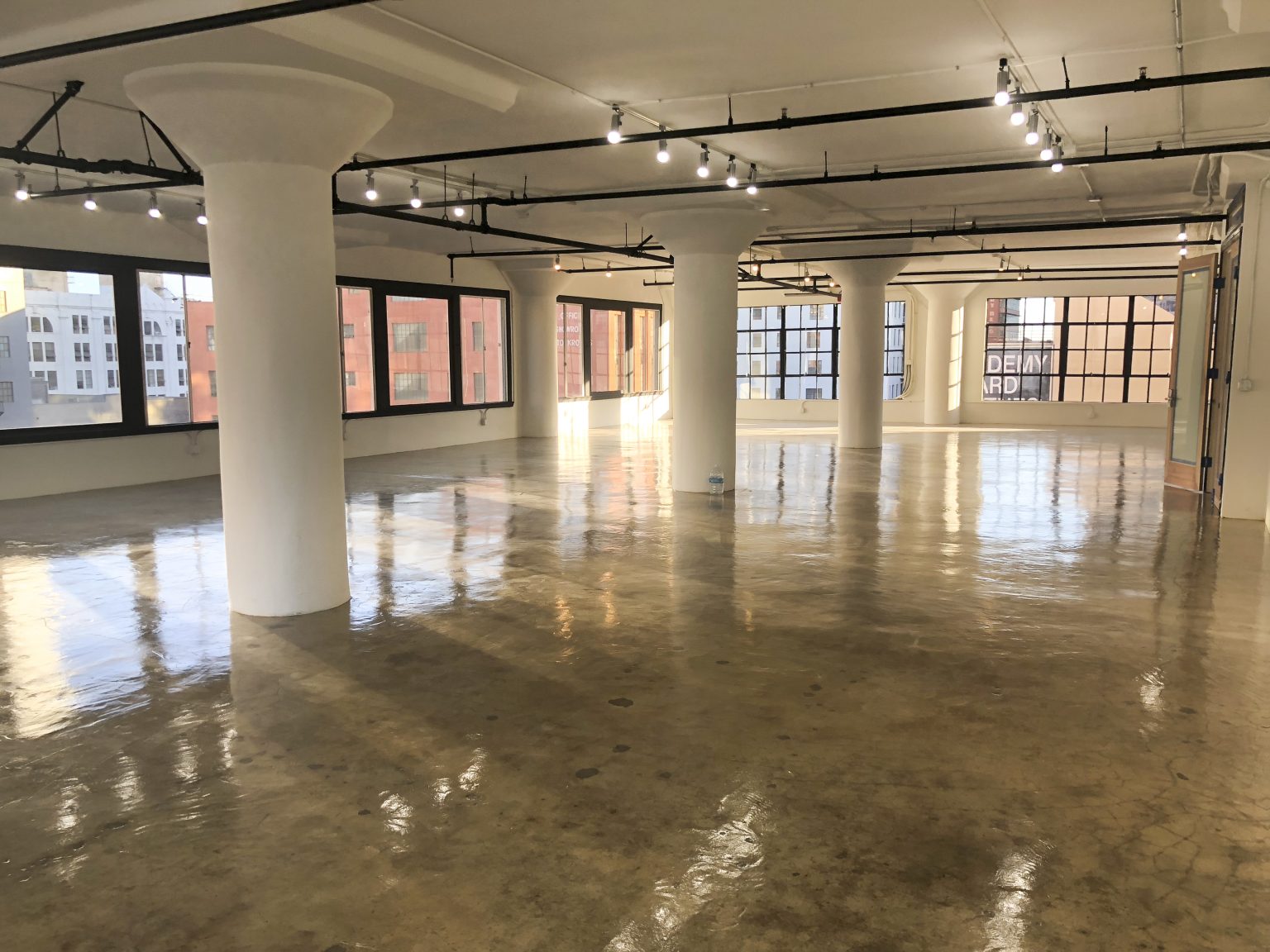
Downtown holds the largest concentration of early twentieth-century commercial buildings in the city, many converted to residential and creative use under the adaptive reuse policy. Their ground floors offer tall ceilings, deep plans and original tile and marble, which is the best stock in Los Angeles for an activation wanting character rather than a blank box.
Broadway holds the largest surviving concentration of 1910s and 1920s movie palaces in the country, several restored as event and retail space and one converted into a flagship store. South Spring Street was the financial center, and the Old Bank District still holds banking halls with vaults and double-height interiors now trading as restaurants, bars and event space. The Spring Arcade Building runs through the block as a covered pedestrian passage of small units, a format far more common in London or Paris than here.
Grand Central Market has anchored 317 South Broadway since 1917 and is one of the most consistently busy pedestrian destinations in Downtown, on weekdays and weekends alike. Pershing Square is the orientation point most people will recognize, with its own Metro station beneath it.
Seventh Street
The main east to west retail street of central Downtown, crossing Olive, Hill and Broadway, and carrying the heaviest pedestrian flow of any Downtown street outside Broadway. It is the street to name when you are describing a central Downtown address to someone who does not know the district. The Bloc sits on it, an open-air retail and hotel complex converted from an enclosed mall and connected directly to the Seventh Street/Metro Center station.
Bunker Hill and Grand Avenue
Grand Avenue is the city’s cultural spine, running past the Walt Disney Concert Hall, The Broad, the Museum of Contemporary Art, the Colburn School and the Music Center. Footfall is driven by performances and exhibitions rather than shopping, so it peaks in the evening and around openings.
The Broad is worth understanding specifically: general admission is free and it recommends a timed ticket while still taking walk-ups daily. Free entry plus timed slots produces a steady flow of visitors arriving at intervals through the day, which is an unusually predictable audience for anything within a short walk. Grand Park runs downhill to City Hall and holds the city’s largest free public events.
One practical note. Angels Flight, the short funicular between Hill Street and Grand Avenue, marks a steep change in level that makes Bunker Hill and the Historic Core feel much further apart on foot than they look on a map.
The Arts District
Converted industrial east of Alameda Street: brick warehouses with tall ceilings, loading docks, roller doors and large open floors. It is the best inventory in Los Angeles for a production, a launch or an installation needing scale, and it is priced well below equivalent space in New York.
Two things to be clear about. There is no continuous retail street and no passing trade: customers arrive for a specific address, which suits a venue, a gallery or a destination restaurant and works against a shop hoping to be discovered. And the district is still partly a working industrial area, with goods vehicles and early-morning operations alongside the galleries, which affects loading, noise and how a street looks at different hours.
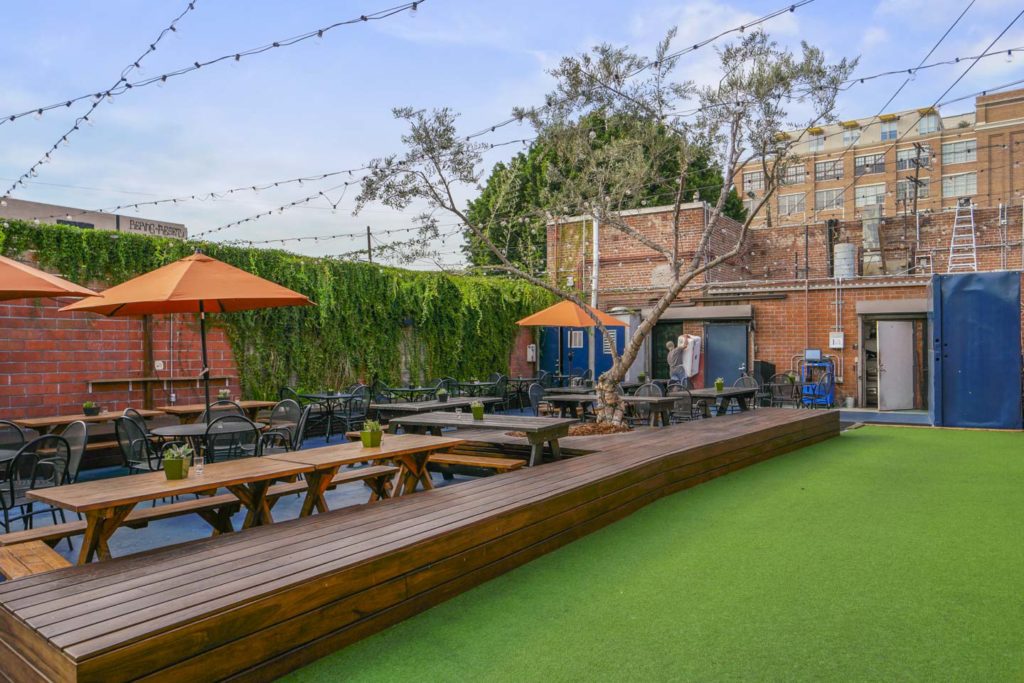
The walkable cluster is around East Third Street, Traction Avenue and Hewitt Street. Addresses further east and south are industrial and much quieter on foot. Large-scale murals cover much of the blank warehouse wall in the district and are a real asset for a brand planning content, though painting one is a permitted alteration rather than a free choice. See space in the Arts District.
The Fashion District
A 107-block area running from Seventh Street south to the freeway and from Broadway east to Essex Street, combining wholesale showrooms, fabric and trim suppliers, manufacturing and open-air public retail within a short walk of each other.
It runs two trades on the same streets and a brief has to say which one it means. The wholesale trade works weekdays out of a handful of large showroom buildings, where the footfall is trade buyers arriving for the building rather than passers-by, and it runs to market weeks several times a year. The public trade peaks at weekends, with Santee Alley as its face: an open-air pedestrian corridor of more than 150 retailers, open every day of the year.
The district also keeps a working apparel manufacturing base, with fabric, trim and production within a few blocks, so sampling and small-run production are locally available in a way they are not in most American cities. The trade-off is access: streets are congested with loading through the working day and parking is genuinely difficult, so treat unloading as a first-order question. See space in the Fashion District.
Little Tokyo and Chinatown
Little Tokyo sits on the eastern side of Downtown and is one of only three surviving historic Japantowns in the United States. Its retail is small-unit and pedestrian in a way little else in Downtown is, arranged around courtyards and plazas rather than along an arterial, with rents below the Historic Core and a genuine mix of local and visiting customers. It gained direct light-rail access through the Regional Connector.
Chinatown, immediately north, runs on very small ground-floor units in courtyard plazas, often only a few hundred square feet, on some of the lowest rents in central Los Angeles. Central Plaza on North Broadway is the historic heart and Chung King Road is a pedestrian-only gallery row, one of the few genuinely car-free retail streets in the city. It has its own light-rail station beside Union Station, which makes it one of the easiest neighborhoods to reach without a car. See space in Chinatown.
The Downtown calendar
Downtown carries more scheduled demand than any other part of Los Angeles, and most of it lands in a narrow band at the start of the year.
| Window | When | What it does |
|---|---|---|
| The LA Art Show | Early January | A large international fair at the convention center that opens the city’s art calendar several weeks before the February fair week. Two distinct windows rather than one. |
| The Grammys | Late January or early February | Held at the arena, and like the Oscars it generates a week of surrounding press and label events rather than demand on the night alone. |
| Fashion market weeks | Several times a year | Buyers come to the Fashion District showroom buildings to place orders. Those weeks are the district’s real rhythm, more than the public fashion week schedule. |
| The Auto Show | November | One of the largest single bookings of Downtown convention space in the year. |
Which district suits which project
- A launch or a party. The Historic Core for character, the Arts District for scale, South Park if you want the arena crowd and have checked the calendar. See event space in Downtown LA.
- A shoot, an installation or a build. The Arts District, without much competition. Large warehouse space is the right category.
- A wholesale showroom or a sample room. The Fashion District, timed to market weeks.
- A small first store or a gallery. Chinatown or Little Tokyo, where the units are small and the rents are the lowest in central Downtown.
- A short-term team or production office. Anywhere on the weekday side. See office space in Downtown LA.
- Walk-in retail. Seventh Street or Broadway, and be honest that Downtown is a weekday proposition unless you are in the Arts or Fashion Districts.
Common questions
Is Downtown LA busy at weekends?
Mostly not. Office and civic traffic make it a weekday district. The exceptions are the Arts District, which is busier at weekends, the Fashion District, whose public retail peaks on Saturday and Sunday, and the arena and convention blocks, which follow an event calendar rather than a week.
Can people get to Downtown without a car?
More easily than anywhere else in Los Angeles. Every rail line converges here, the Regional Connector joined them in 2023, and Union Station adds Amtrak and Metrolink. It is also the one part of the city where parking is paid and structured rather than free, so it is worth telling guests which station to use.
What kind of buildings will I be looking at?
Downtown holds the largest concentration of early twentieth-century commercial buildings in the city, many converted under the adaptive reuse policy. Expect tall ceilings, deep floor plans and original detail in the Historic Core, and brick warehouses with roller doors and loading docks in the Arts District.
Where is the cheapest space in Downtown?
Chinatown and Little Tokyo, where the units are small, often only a few hundred square feet, and arranged around courtyards. Both suit a single-brand pop-up, a gallery or a test store better than a large activation.
What is the difference between the Fashion District’s two trades?
Wholesale runs on weekdays out of the large showroom buildings and answers to market weeks. Public retail peaks at weekends, with Santee Alley as its face. Same streets, different customer, different day. Be clear which one you are planning for.
Is the Arts District good for a shop?
For a destination, yes. For a shop hoping to be discovered, no. There is no continuous retail street and no passing trade, so customers arrive for a specific address. That suits a venue, a gallery or a restaurant, and it suits an installation best of all.
Where to look next
Browse event space, office space, retail and pop-up space or galleries and studios across Downtown LA, or the neighboring Arts District, Fashion District and Chinatown.
For the wider city, our Los Angeles guide covers how Downtown compares with Hollywood, the Eastside and the coast, and the Hollywood guide covers the other end of the B Line. For the Westside, the West Hollywood guide covers a separate city with its own permits, and a very different rhythm from Downtown. At the far end of the E Line, the Santa Monica guide covers the only beach city in the county you can reach from here by rail. The Beverly Hills guide covers the other separate city on the D Line.

Written by
Adrien Kerbrat is Chief Revenue Officer and co-founder of Storefront. With more than 10 years in commercial real estate, he is an expert on the French market and short-term retail across Europe. Based in Bordeaux and often in Paris, he writes on pop-up strategy, retail location, and the French retail landscape.
More from Adrien Kerbrat →Related posts:
 Hollywood Neighborhood Guide: Pop-Up Shops, Event Spaces, and Showrooms in Los Angeles
 Shoreditch Neighborhood London Guide: London’s Hipster Hangout and Pop-Up Capital
 Mayfair Neighborhood Guide: Luxury Pop-Up Shops, Showrooms, and Galleries in London
 Pigalle Neighborhood Guide: Pop-Up Shops, Showrooms and Creative Spaces
 What Is Local SEO and How Do I Get My Business Found?