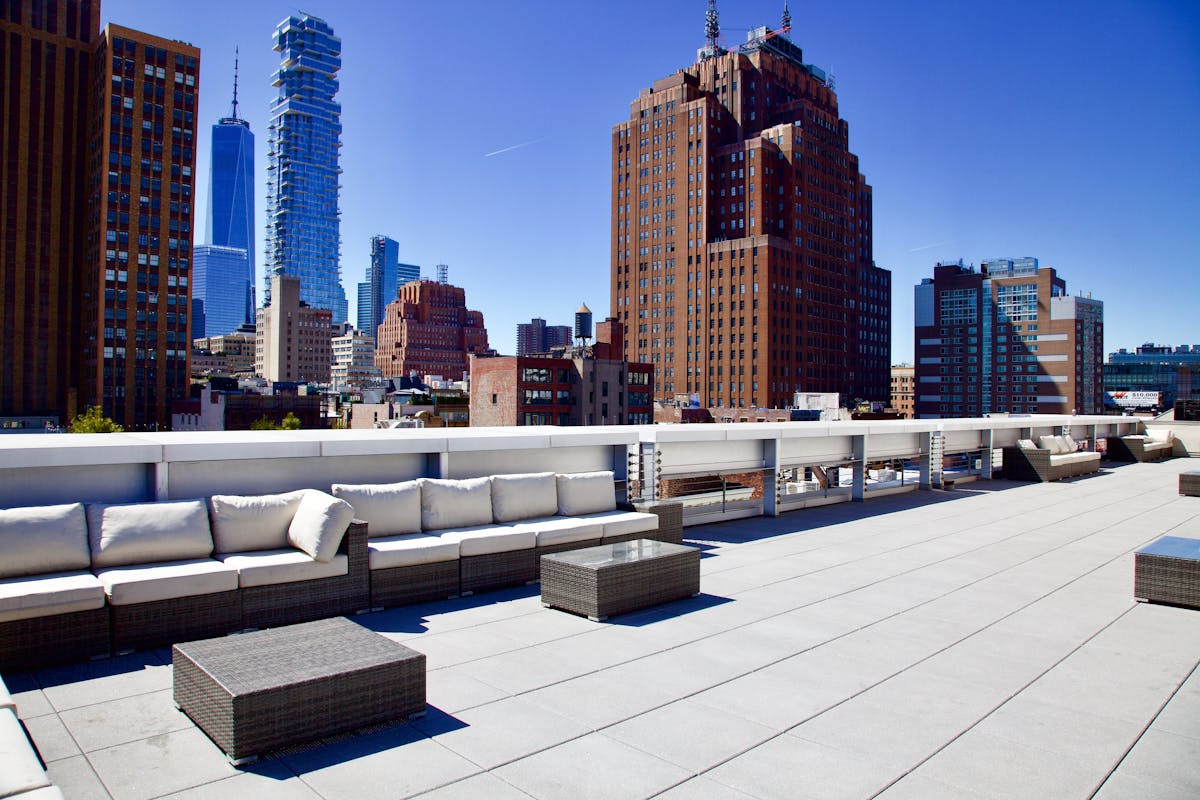




What to look for in a London rooftop rental
A rooftop rental in London gives an event a setting that a ground-floor venue cannot. Elevated sightlines, open sky and the scale of the city behind a speaker or a product display are difficult to replicate indoors. The practical considerations are different too: weather cover, load-in logistics, noise limits and access routes all need checking before a booking, and they vary considerably from one building to the next.
Rooftop spaces in London range from converted industrial terraces in east London to penthouse-level platforms above Mayfair. The right space depends on the size of the group, the nature of the activity, and how much of the skyline you want behind it.
Rooftop hire by use case
Different buyers come to rooftop hire for different reasons, and the space type that suits each one varies.
-
Brand launches and product reveals work best on rooftops with clear sightlines and enough flat space for a staging area. Shoreditch and the surrounding east London districts offer former warehouse and light-industrial buildings whose upper floors have been converted to event-ready terraces. The customer base in those areas skews creative and the spaces suit brands wanting an arts-and-commerce backdrop.
-
Corporate functions and private hire for larger groups tend to gravitate toward Canary Wharf and the City, where rooftop spaces sit above office towers and offer river views and a more formal setting. Footfall in those districts is office-driven and predominantly weekday, which can work in favour of a Thursday evening function.
-
Intimate gatherings and private entertaining fit better with the smaller rooftop terraces in Mayfair, Notting Hill and Marylebone, where buildings are lower, layouts are more residential in feel, and the surrounding streets are quieter.
Neighbourhoods with rooftop spaces on Storefront
-
Shoreditch is the highest-demand short-term rental district in London. Its former warehouse and light-industrial stock provides wide upper-floor terraces and raw interiors, and the area trades hardest in the evenings and at weekends. For a rooftop hire aimed at a young creative audience, it is the most natural starting point in London.
-
Canary Wharf is a privately managed financial district with office towers that offer rooftop access and river views. Footfall is predictable and weekday-weighted, which suits a corporate rooftop hire or a product reception for a professional audience.
-
Mayfair is the luxury address of London. Rooftop spaces here sit above streets occupied by established fashion houses and galleries, and the postcode carries a prestige that suits brands wanting that adjacency.
-
Covent Garden is a high-visitor-flow managed estate with a mix of large and small-unit spaces. Rooftop access in this area benefits from the dense footfall of the surrounding streets and from an audience that is already in a spending and discovery mindset.
-
Battersea has changed faster than almost anywhere in London, with the power station redevelopment adding a large managed destination alongside more established neighbourhood stock. The Thames-facing aspects of buildings here give rooftop spaces a distinct outlook.
When to book a rooftop in London
Demand for rooftop hire in London peaks between late spring and early September, when outdoor events are more reliably viable and the evenings are long enough to make the most of an elevated setting. That window also overlaps with London's main visitor season, so the most sought-after spaces in central and east London book up earlier in the season than equivalent indoor spaces.
Autumn brings a secondary peak around Frieze London and Frieze Masters, expected in October 2026, when gallery and brand activity across the city increases. Spring and early autumn also align with London Fashion Week, expected in September 2026, which drives demand for creative, photogenic venues across the city.
Winter rooftop hire is less common but not unusual. Covered terraces, heated outdoor areas and spaces with partial enclosure extend the usable season for corporate receptions and private hire. Prices and availability tend to be more flexible outside the May-to-September window.
Practical considerations for rooftop hire in London
A few things are worth confirming before committing to any rooftop space:
-
Weather cover. London's weather is unreliable in any month. An uncovered rooftop is a risk even in summer. Check whether the space has a canopy, retractable cover or contingency indoor area.
-
Load-in and access. Upper-floor spaces rely on lifts or staircases for all equipment, furniture and catering. Narrow stairwells in older buildings can rule out certain set-ups entirely. Confirm the access route and the lift dimensions before booking.
-
Noise and neighbours. Amplified music on an open rooftop carries further than the same volume inside. Many central London rooftop spaces have curfews or decibel limits agreed with the building or the local authority. Confirm these with the space owner before finalising an event programme.
-
Congestion and delivery. Central London sits inside the Congestion Charge zone, which operates on weekdays and at weekends. Deliveries and fit-out scheduled during those hours carry an additional cost. The Ultra Low Emission Zone covers every London borough and runs every day except Christmas Day.
For events involving alcohol, food service or regulated entertainment, a Temporary Event Notice may be required. The space owner is the right person to advise on what is needed for a specific space and activity. Requirements around insurance and deposits are agreed directly with the space owner and vary by space, duration and type of activity.
For more on insurance obligations, the Insurance for Pop-Up Shops in London: Key Types of Cover and What to Know guide covers the key types of cover relevant to short-term space hire.
For a broader view of flexible space across the city, browse loft spaces for rent in London or explore the full London inventory on Storefront.
FAQ
Can I book a London rooftop for a single day or a few hours?
Yes. Most rooftop spaces on Storefront are available for short-term hire, including half-day and full-day bookings. The minimum duration and pricing are set by the individual space owner and shown on the listing. Enquire directly through the platform to confirm availability for your preferred dates.
What rooftop spaces are available in Soho and the West End?
Soho has a dense mix of upper-floor and rooftop spaces above its characteristic narrow frontages. Units tend to be compact and characterful rather than large-format. Browse the Storefront Soho listings to filter by capacity and availability.
What happens if the weather is bad on the day of my event?
This depends on the individual space. Some rooftop rentals have weatherproof canopies, retractable covers or adjacent indoor areas that function as a fallback. Others are fully open-air. Confirm the contingency option with the space owner before booking, and clarify the cancellation or rescheduling terms set out in the listing.
Do I need planning permission to use a rooftop for a commercial event?
For most short-term events in England, planning permission is not required. Permitted development rules allow land to be used for temporary purposes for up to 28 days per calendar year without a planning application. For longer or recurring use, or for any structural changes to the space, the position is different and worth confirming with the space owner or local authority.
How far in advance should I book a rooftop space in London?
For peak-season dates between late spring and early September, and around major events such as London Fashion Week and Frieze London, booking several weeks or months in advance gives the widest choice of spaces. Outside those periods, rooftop spaces are generally more available and booking lead times are shorter.


