Canary Wharf is a Metropolitan centre in east London, graded by the London Plan as serving a catchment that stretches across several boroughs. The retail here is almost entirely below ground, running through connected malls that link the stations to the towers above. With more than three hundred shops and restaurants on site, a shop to let in Canary Wharf places a brand inside an established retail circuit rather than on an open high street.
How the estate works for tenants
Unlike most of London, where commercial property is split across hundreds of individual landlords, Canary Wharf is controlled by a single owner. That means one counterparty, one set of terms and one letting process for every unit on the estate. For a brand looking for a shop to rent in Canary Wharf, this is a material advantage: the process is closer to taking space in a shopping centre than negotiating with a private freeholder on a high street.
Access, opening hours, servicing and fit-out standards are all set by the estate rather than by the occupier. There is no street frontage and no pavement trade. Everything depends on position within the internal walking routes that connect the stations to the office towers.
Weekday trading pattern
The estate trades on the sharpest weekday clock in London. There is a hard lunchtime peak as office workers move through the malls, a shorter early evening peak, and very little footfall in between or at weekends. A residential population has been added to soften that cycle, but any shop to let in Canary Wharf should still be evaluated against five working days rather than seven.
This pattern suits businesses whose customers are the local workforce: food, convenience retail, personal services and professional clothing all trade well here. Brands that depend on weekend browsers or evening destination shopping will find the rhythm harder to work with.
What units look like
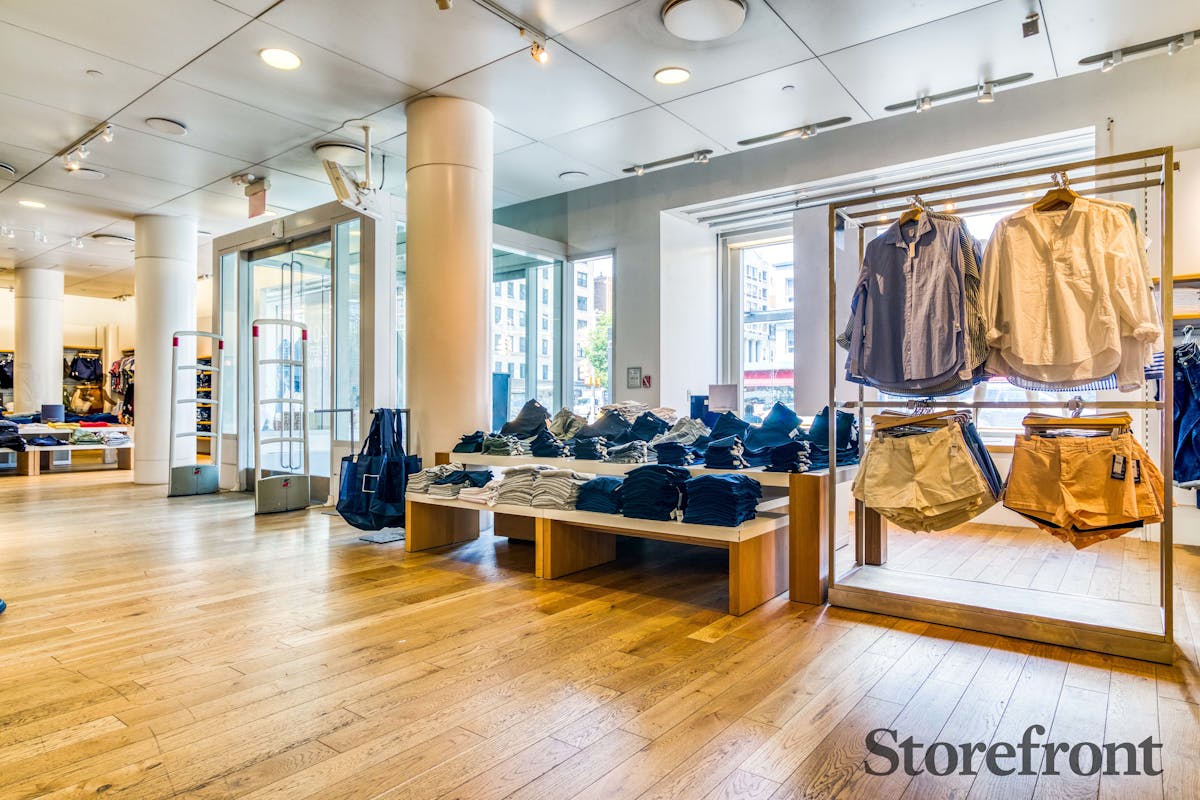
Because the retail is mall-based, units in Canary Wharf tend to be purpose-built with consistent ceiling heights, servicing corridors and standardised frontages. That is different from the narrow Victorian shopfronts found across most of London, where a brand works vertically over two or three floors with limited rear access.
The estate format means fit-out is governed by the landlord's specifications. Brands considering a small storefront will find the controlled environment easier to work within, though the trade-off is less freedom over signage and external presentation than an independent high street would allow.
Location and connections
Canary Wharf sits in the E14 postcode in east London. It is served by several stations, including Canary Wharf DLR, which is among the hundred busiest stations in London by annual entries and exits. That volume is a useful proxy for the through-traffic a ground-floor unit can expect.
The estate is well connected by rail and bus, and other stations serving the immediate area include Heron Quays, West India Quay, Blackwall, South Quay, Poplar, All Saints, Crossharbour and Westferry. For brands exploring retail space for rent across London more broadly, Canary Wharf offers a contained, high-footfall environment distinct from the city's traditional high streets.
Seasonality and demand
Demand for retail space in London peaks around the fashion weeks in February and September, through the run-up to Christmas, and again around the autumn art and design festivals. In Canary Wharf specifically, the office-driven footfall means August is quieter than the rest of the year, as a share of the workforce takes leave.
Black Friday marks the start of the Christmas trading run, and Boxing Day on 26 December opens the winter sale period, one of the highest-footfall trading days of the year. Brands planning a storefront with apartment for a longer residency may find the autumn-to-Christmas window the strongest period to commit to.
Frequently Asked Questions
What type of retail units are available to let in Canary Wharf?
Shops to let in Canary Wharf are mall-based units in linked underground retail corridors beneath the office towers. They are purpose-built with standardised frontages and managed centrally by the estate owner, with access, opening hours and fit-out all controlled.
When is footfall highest in Canary Wharf?
Footfall peaks at lunchtime and again in the early evening on weekdays, driven by the surrounding office population. Weekends are significantly quieter, and any unit here should be evaluated against a five-day trading week.
How does letting work in Canary Wharf compared to a London high street?
Canary Wharf is a single-owner estate, so there is one counterparty and one set of letting terms for every unit. This is closer to taking space in a shopping centre than negotiating with an individual landlord on a high street, and the process is generally more straightforward.
What postcode covers Canary Wharf?
The postcode covering Canary Wharf is E14. Note that postcodes in London do not always follow district boundaries exactly, so a unit described as Canary Wharf may occasionally carry a neighbouring code.